Physics

OVERVIEW
Physics helps us understand the fundamental principles of the universe and develop technologies that shape the future. It is an essential subject for those curious about how the world works and eager to contribute to advancements in science and engineering.

If you have a logical mind and you are curious to find out about everything from the smallest sub-atomic particle to the structure of the largest galaxies, then physics is for you. Studying physics at King’s involves a mixture of theory and practical work in first-rate, well-equipped laboratories. As a highly regarded A-level, it enables not only scientific and engineering careers, but it is also prized for other courses such as business and law. Logical thinking is the core of the subject and this opens up more career opportunities than almost any other skill.
During the A-level course you will get the chance to visit the world’s largest scientific experiment, the Large Hadron Collider at CERN, as well as other trips to university laboratories. In recent years we have also visited Oxford, Bristol, Exeter and Bath. Be part of the adventure!

Pupils are actively encouraged to use the most up-to-date sources of information and equipment, such as Data Harvest Bluetooth data-loggers, to enhance the learning experience. Pupils have the opportunity to take part in the Physics Olympiad competition, Science Society activities and visits to lectures. There is an annual departmental trip to CERN near Geneva.
The relevance of physics to pupils’ everyday lives and its importance to a modern technological society is fundamental to the department’s work. We also help pupils to understand how physics is involved in a wide variety of careers. Good physics graduates are highly numerate problem-solvers. They are particularly sought after in the rapidly developing sectors of quantitative finance, telecommunications, information technology and law.
OUR SYLLABUS
Building on GCSE knowledge, students explore familiar topics in greater depth while encountering new subjects such as capacitors, cosmology, and nuclear and medical physics.
Students follow the OCR A Physics course, covering both theoretical concepts and practical assessments (PAGs) and additional non-assessed experiments to support learning. Key topics include gravitation, electromagnetism, circular and simple harmonic motion, astronomy, and medical physics.
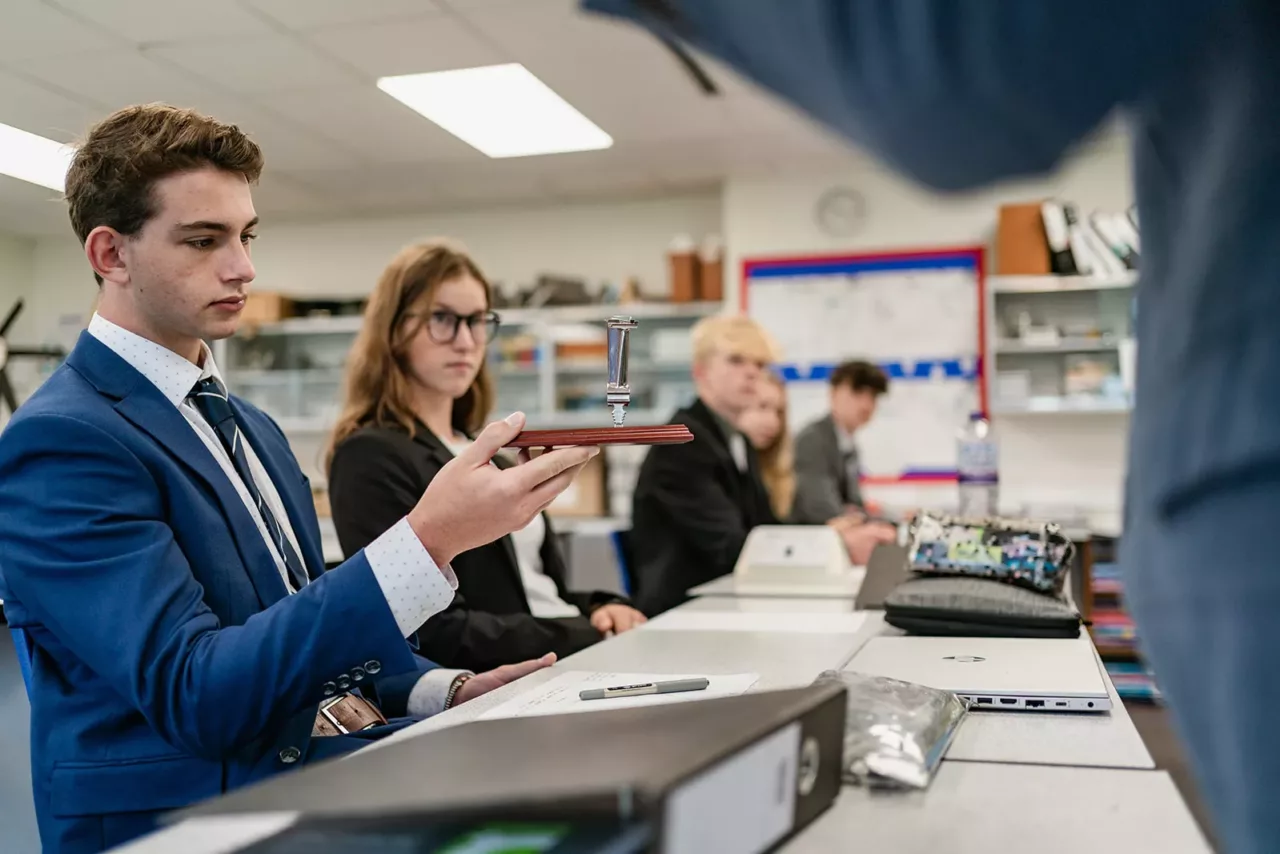
WHY STUDY PHYSICS?
Do you ever wonder why things are like they are? Why the universe exists? What makes the world go around? What is ‘matter’?
If you have a logical mind and you are curious to find out about everything from the smallest sub-atomic particle to the structure of the largest galaxies, then physics is for you. As a highly regarded A-level, it enables not only scientific and engineering careers, but it is also prized for other courses such as business and law. Logical thinking is the core of the subject and this opens up more career opportunities than almost any other skill.
Highlight of the Sixth Form physics experience is the Year 13 trip to the CERN Particle Accelerator outside Geneva. More locally, we have taken advantage of the building of the new Hinkley Point reactor and enjoyed their education centre annually. The physics department has taken pupils to local universities for space talks, and Earth and Moon exhibiions.
The Young’s Physics Society offers pupils the opportunity to present on topics of their choice and engage in critical discussions. Pupils from the society have also assisted the department with visiting junior schools during science days.
Physics, alongside Mathematics, is one of the most enabling A-level subjects, opening doors to a vast range of careers, from computing and engineering to law, finance, and fundamental research.
Graduates have gone on to become engineers at Rolls-Royce and other leading firms, computer analysts, physics teachers, accountants, and lawyers.
James Crocker (Rolls-Royce)