Modern Foreign Languages

OVERVIEW
Students traditionally study Spanish, German, and French, with options to take private weekly classes in Russian, Chinese (Cantonese and Mandarin), Italian, and Japanese.
We continuously expand language offerings based on demand and provide guidance on exam and tuition availability for other languages. Students can also pursue Accreditation in Languages for Business (ALB) in German, French, and Spanish, equipping them with international workplace communication skills.

At King’s, Modern Foreign Languages are taught with a clear focus on preparing pupils for the professional world. Beyond excellent examination results, our pupils benefit from a programme designed to equip them with the skills, cultural awareness and confidence needed to succeed at university, in employment, and in an increasingly global society.
As Noam Chomsky reminds us: “A language is not just words. It’s a culture, a tradition, a unification of a community, a whole history that creates what a community is.” At King’s, we embrace this view, showing our pupils how language learning deepens understanding of both themselves and the world around them.

At King’s, Modern Foreign Languages are taught with a clear focus on preparing pupils for the professional world. Beyond excellent examination results, our pupils benefit from a programme designed to equip them with the skills, cultural awareness and confidence needed to succeed at university, in employment, and in an increasingly global society.
As Noam Chomsky reminds us: “A language is not just words. It’s a culture, a tradition, a unification of a community, a whole history that creates what a community is.” At King’s, we embrace this view, showing our pupils how language learning deepens understanding of both themselves and the world around them.

What makes MFL at King’s distinctive:
• Professional links: We maintain strong connections with the University of Bath and the University of Exeter, giving pupils access to inspiring academic lectures, workshops and career-focused talks.
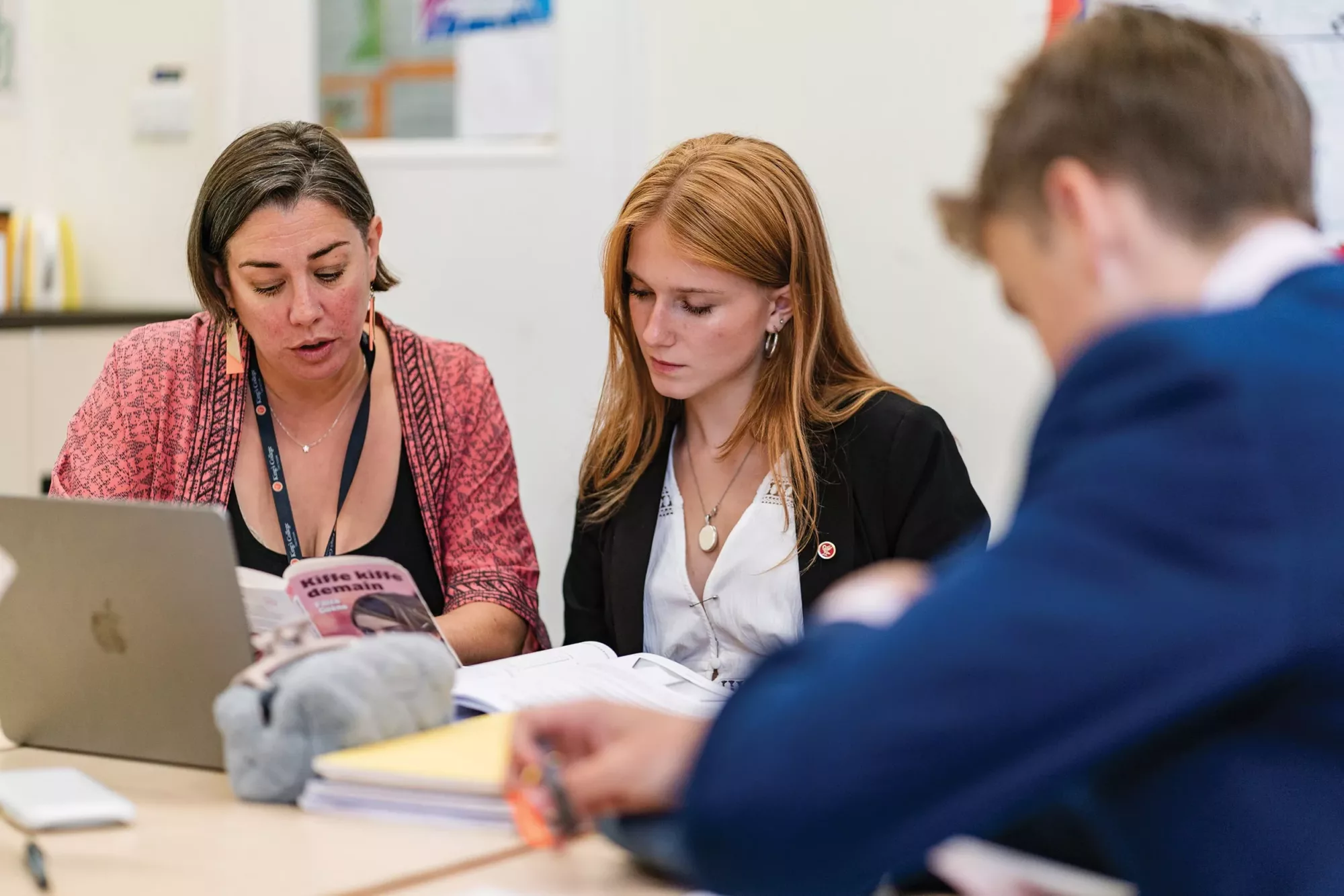
• Speaking focus: Every Sixth Former benefits from one hour of individual speaking lessons each week with a native speaker, included within school fees — ensuring confidence and fluency.
Teaching excellence: Most of our teachers are native or near-native speakers, bringing authentic insight into the languages and cultures they teach. The department also prioritises professional development — all teachers undergo annual training to refine their teaching skills, and several are external examiners for A-level and GCSE examining boards, ensuring the highest academic standards.
• Academic pathways: The MFL Department is one of the leading contributors to Oxbridge admissions at King’s, and many of our linguists go on to study at the most prestigious universities in the UK and worldwide.

At A-level, most pupils study French, German or Spanish, though there are also opportunities to pursue Russian or Chinese (Mandarin and Cantonese) through weekly private tuition. We continue to expand our provision to meet pupil interest; if you wish to study a language not listed, please enquire as we are often able to arrange tuition and exams.
Beyond the classroom, pupils develop their skills in authentic contexts. The MFL Sixth Form Society meets monthly to enjoy films, lectures, debates and cultural discussions. We also encourage pupils to take part in national competitions such as the GCHQ Linguistic Competition, the Anthea Bell Prize for Creative Translation and the UK Linguistics Olympiad. These opportunities broaden horizons, inspire ambition, and give pupils a competitive edge for the future.
OUR SYLLABUS
We follow the AQA syllabus. The course includes:
- Cultural and Contemporary Studies: Students explore topics such as politics, history, sociology, law, architecture, and cuisine in the target language.
- Literature and Film: In Year 12, students study a film; in Year 13, they analyse a literary work.
Our new Accreditation for Business course enables those not studying an A-level to develop their linguistic skills, and includes:
- Writing a job application letter
- Responding to work-related emails
- Understanding workplace regulations and instructions
- Interpreting travel-related announcements and directions
- Delivering product or service presentations
- Engaging in customer-focused dialogues
WHY STUDY MODERN FOREIGN LANGUAGES?
Learning a language is life-changing, offering deep cultural immersion and valuable skills sought by employers, such as analytical thinking, memory retention, intercultural awareness, and strong communication abilities.
Students pursuing ALB can achieve Level 3 certification through a two-week residential programme in France, Germany, or Spain. We also run biannual trips to these countries.
We maintain strong ties with modern languages faculties at the University of Exeter and the University of Bath. A-level students attend lectures and career talks, providing insights into language-related professions.
The Languages Ambassadors initiative started in 2020 and it aims to provide sixth form pupils with the opportunity to promote their love for different languages and cultures. They represent the global community at KCT.
Language ambassadors are in charge of creating and launching whole school events such as the Day of Languages and Cultures. They also contribute to the widespread love for languages in other schools. For example, they will be teaching linguistics to Year 5 Holy Trinity pupils in March.
Through this programme, they learn life skills which are helpful for their future careers such as communication skills in an international setting, team work, leadership, meeting deadlines, or public speaking.
Language learners develop resilience, adaptability, and problem-solving skills. They gain cultural awareness and the ability to work across diverse environments, fostering collaboration, respect, and open-mindedness—essential qualities in today’s global society.
Languages complement a wide range of careers, from linguistics and acting to business, politics, and international charity work.
Freya Jenkinson and Lola Milton-Jenkins (both currently reading language degrees at Oxbridge).