Stand for Attention
What held your attention today? Please spend a moment thinking about this and perhaps ask the same question of your friends, parents, son or daughter.
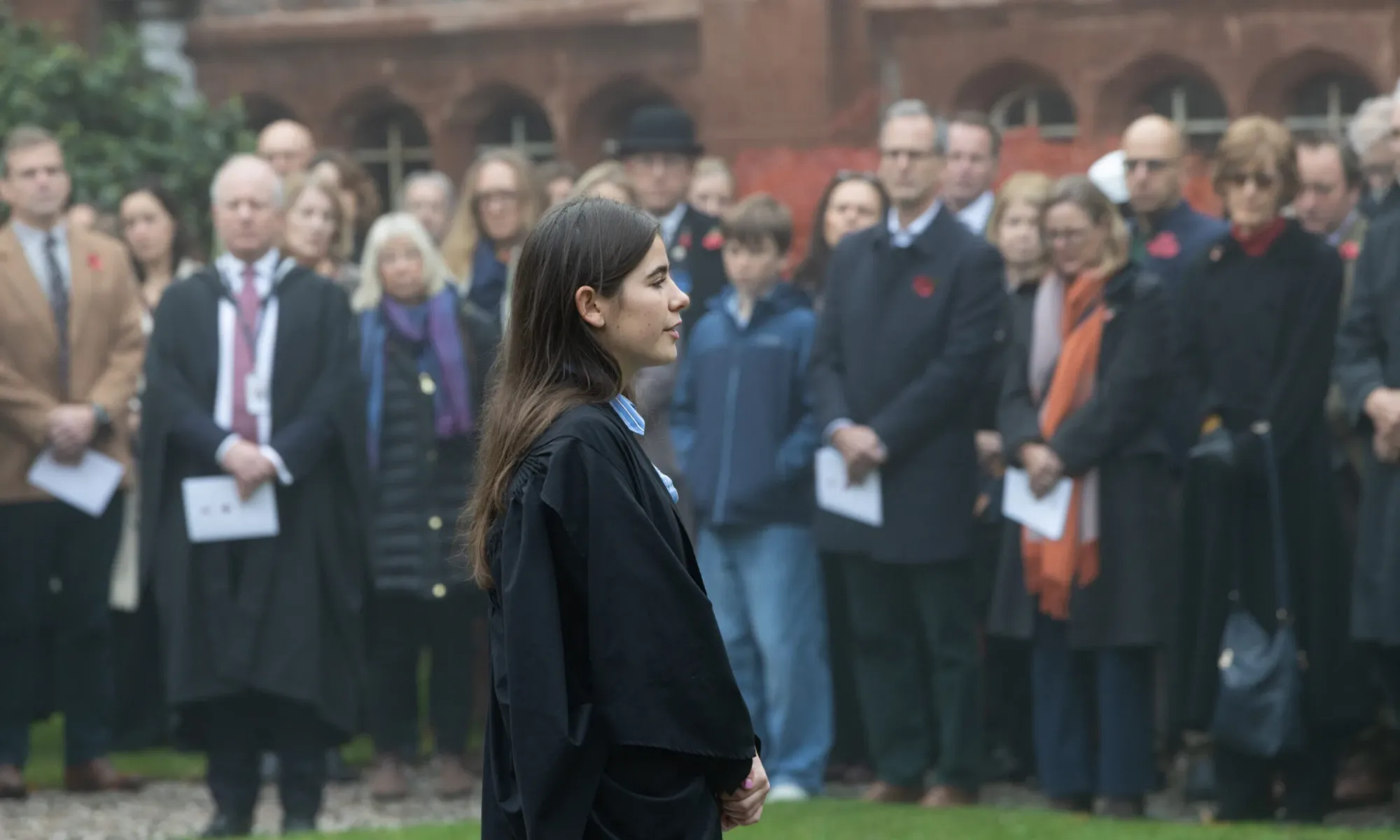
I spent two minutes in rapt attention at precisely 1100 this Wednesday morning, just after I listened to The Last Post played outside Meynell house. No sound except the birds; an inbuilt need to focus fully on thoughts concerning remembrance; a duty to spend that brief time in respectful observance. But perhaps this is cheating because I was forced to attention by external factors.
Attention is a commodity, perhaps even a form of literacy. Our attention is something of great value, but it is also something that has never been exposed to greater competition, nor been more likely to be splintered.
We live in a world where our attention is monetised and aggressively competed for by the most valuable companies on Earth. It therefore makes sense to value it at least as much as they do. Otherwise, we will be dictated to by their bottom line. If we value our attention and ensure that the currency of our attention remains high, we can enact a small act of defiance, a way of asserting control when so much seems out of our control.
This quote from Herbert Simon is as old as decimalisation, but it rings true in 2026 just as it did in 1971:
“In an information-rich world, the wealth of information means a dearth of something else: a scarcity of whatever it is that information consumes. What information consumes is rather obvious: it consumes the attention of its recipients. Hence, a wealth of information creates a poverty of attention and a need to allocate that attention efficiently among the overabundance of information sources that might consume it.”
A wealth of information creates a poverty of attention. Information is machine-gunned our way from social media, 24-hour news, podcasts, and the semi-informed opinions of others. Much of it is neither absorbed nor scrutinised. It simply serves to scramble our thoughts and force the single beam of our attention through a metaphorical prism. The information forced upon us is perhaps best considered like a long spell from a challenging opening bowler. You are better off letting the majority of balls pass harmlessly to the ‘keeper, and judiciously deciding which occasional delivery should commend your full attention as you caress it to the boundary.
Some of the most memorable and meaningful experiences have been where I forced myself into a state of attention. George Orwell’s Coming Up for Air commanded my attention – it struck a chord with me and enabled me to blot out all the noise of the bus as I trundled into school. Virginia Woolf’s The Waves offered the opposite experience – its overwrought prose, designed to give the illusion of flow, made it necessary to force my attention onto the text and eventually to gain a semblance of enjoyment. Listening to jazz always captures my attention naturally, and it’s easy to float away on the music, but watching Jacob Bronowski’s Ascent of Man or Aaron Sorkin’s classic The West Wing both required me to force myself into a state of concentration in order to keep up with the sheer intellectual breadth of the former or the plot complexity of the latter. There is something satisfying about very specific focus and concentration – knowing that you share the moment with just one thing, and the rest of the world can wait.
We should ask children, even in the early years: what do you choose to give your attention to? To technology, algorithms, Big Tech; or to people, books, thinking, and ideas? What deserves our attention? Because the answer to that question could be one of the most important choices you make in how you live your life.
It is always good to finish on a quote, and the wise owl Susan Sontag perhaps summed it up best when she said “Attention is vitality. It connects you with others. It makes you eager. Stay eager.” I like eagerness, especially when combined with unshakeable and closely observed attention.
— Mr Benjamin Evans, Headmaster